
Large components create a different sleeve-selection problem from small wires and standard hose sizes. As diameter increases, fitting clearance, braid expansion, installed length, wall geometry and available installation space become more important to the finished assembly.
A large diameter silica sleeve may be required around an oversized hose, process pipe, duct, cable bundle or irregular component exposed to high temperatures. The correct size should not be selected from nominal diameter alone. The manufacturer and buyer need to agree what the sleeve must fit over, how it will be installed and what dimensions must be maintained after installation.
BSTFLEX supplies standard and custom products within its silica sleeve range. Large or non-standard diameters can be reviewed according to the actual assembly, required length, textile construction and production quantity.
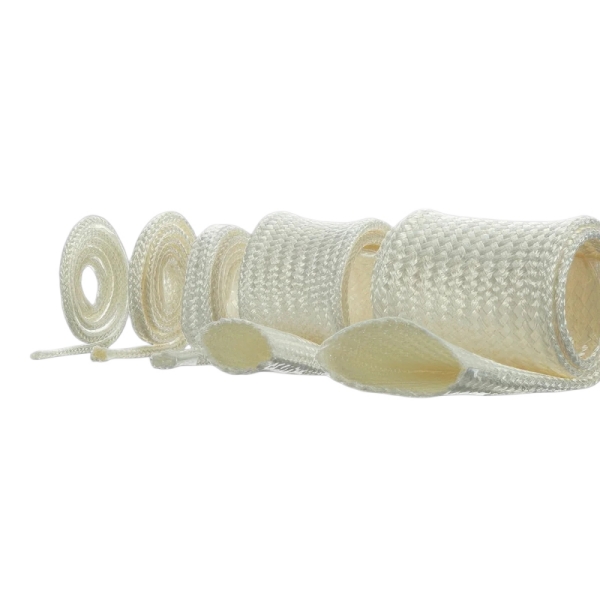
Large Diameter Is an Assembly Requirement, Not a Fixed Number
There is no single diameter at which a silica sleeve automatically becomes a large-diameter product. A size that is routine for a straight pipe may be difficult when the same sleeve must pass over a flange, connector, hose ferrule or irregular bundle.
For purchasing purposes, treat the project as a large or custom-diameter requirement when one or more of the following conditions apply:
- The required inside diameter falls outside the normal production range.
- The sleeve must pass over a much larger fitting before returning to a smaller operating diameter.
- The protected component is oval, bundled or irregular rather than round.
- The installed outside diameter is restricted by nearby structures.
- The sleeve must follow a large component through bends or changes in section.
- Diameter, wall structure and length need to be developed together for an OEM assembly.
This approach is more useful than specifying only “large bore silica sleeve” without an assembly drawing.
Start With Four Diameters, Not One
A custom sleeve inquiry should identify the dimensions that control manufacturing, installation and service. For many oversized assemblies, four diameter values are more useful than one nominal ID.
| Dimension | What It Controls |
|---|---|
| Normal component OD | The outside diameter of the hose, pipe, cable bundle or component during normal installation. |
| Maximum pass-over OD | The largest fitting, connector, coupling, weld feature or temporary obstruction the sleeve must pass over. |
| Required installed sleeve OD | The maximum outside envelope allowed after the sleeve is fitted. |
| Local maximum OD | Any short section that becomes larger because of a branch, bend, clamp zone or irregular component geometry. |
If these four values are identical, selection is straightforward. If they differ substantially, a nominal inside diameter by itself does not describe the installation.
For general diameter and wall-thickness selection, see the silica sleeve diameter and construction guide. The focus here is the additional work required when the assembly is oversized or outside normal catalog geometry.
Maximum Pass-Over Diameter Can Control the Entire Design
Consider a large hose with a relatively consistent body diameter and a much larger end fitting. If the sleeve is installed after the fitting has been assembled, the sleeve may need enough radial flexibility to pass the fitting without unacceptable opening of the braid or loss of installed length.
That does not mean the finished sleeve should simply be ordered at the fitting diameter. An oversized sleeve may become unnecessarily loose along the hose body, increase the installed envelope and make retention more difficult.
Before production, decide whether the sleeve will be:
- installed before fittings are assembled;
- expanded over an existing fitting;
- used only on the straight body section;
- installed as several shorter sections around local obstructions;
- developed as another custom protection arrangement where tubular installation is impractical.
The assembly sequence can therefore determine the most practical custom diameter silica sleeve more strongly than the component's nominal size.
Large Braided Sleeves Change Length as Diameter Changes
A braided tubular structure can alter its length as the braid angle changes. Expanding the sleeve over a larger diameter generally changes the axial geometry as well.
This effect matters more on long, large-diameter pieces because a small geometric change per unit length can become significant across the complete assembly.
For a large diameter braided silica sleeve, evaluate both:
- the free or supplied length before installation; and
- the required coverage after the sleeve has been fitted to the actual diameter.
Do not assume that a sleeve supplied at one free-state length will provide exactly the same installed coverage on every diameter. Where coverage is critical, approve the sleeve on the real component or a representative mandrel before fixing the production length.
The braided silica sleeve guide provides additional information on radial expansion, connector pass-over and routed assemblies.
Large Diameter Does Not Automatically Mean Heavy Wall
Inside diameter and wall construction are separate purchasing parameters. A larger sleeve is not automatically thicker, and a thicker wall is not automatically the correct choice for an oversized component.
Additional wall volume may increase the finished outside diameter, reduce flexibility and require more installation space. These effects become more important as circumference increases.
When a project needs additional insulation volume or a particular wall construction, specify that requirement separately from the inside diameter. BSTFLEX can review the available construction for the selected product rather than treating “large diameter” and “heavy wall” as the same specification.
Large Hoses Need Fitting and Movement Data
Large hydraulic, pneumatic and industrial hoses can combine substantial outside diameter with bulky couplings and dynamic movement. A sleeve that fits in a straight static position may behave differently when the hose bends through its service range.
For a silica sleeve for large hose, provide:
- actual hose OD;
- ferrule and fitting OD;
- minimum bend radius;
- movement range;
- required protected length;
- location of clamps and supports;
- distance from the heat source;
- available radial clearance.
Check the installed sleeve at the inside and outside of the tightest bend. Excess material can bunch on the inside radius while the outside radius becomes more extended.
Where the hose is dynamic, approve the complete assembly through the intended movement range rather than evaluating only a straight sample.
Large Pipe and Tube Applications Need a Different Fit Review
A process pipe is often more dimensionally stable than a flexible hose, but the installation can include welds, elbows, couplings, sensors and support structures that change the local geometry.
When specifying a silica sleeve for large pipe, distinguish between two different duties.
Direct Insulation of the Hot Pipe
The sleeve is installed around the heat source itself. Pipe surface temperature, installed wall structure, required external thermal condition and available clearance are important.
Protection of a Pipe or Tube From an External Heat Source
The pipe or tube is the component being protected. The heat source may be an exhaust system, furnace or nearby process equipment. Distance from the heat source and the allowable component temperature become important.
For more detail on those two duties, see the silica sleeve for pipe and tube thermal protection guide.
Cable Bundles Are Rarely Perfect Cylinders
A large cable bundle may have an oval or irregular cross-section, especially where several cables are tied together. Measuring only across the narrow dimension can result in a sleeve that is difficult to install.
For a silica sleeve for cable bundle, provide:
- maximum bundle width;
- maximum bundle thickness;
- bundle circumference where useful;
- branch locations;
- connector dimensions;
- minimum bend radius;
- required access points.
Where the bundle changes shape during bending, evaluate the maximum installed envelope through the intended routing. A nominal round ID should not be treated as a perfect description of an irregular harness.
Irregular Components May Need a Trial Mandrel
For a large or non-circular part, a representative mandrel can give the supplier and buyer a common reference before production tooling or full assembly trials.
The trial should reproduce the dimensions that control fit, including local enlargements and bend geometry where relevant.
Record:
- sleeve size and construction;
- mandrel or component dimensions;
- free-state sleeve length;
- installed coverage;
- installed outside diameter;
- condition of the braid after installation;
- any end-treatment or retention requirement.
A sample approved only on a small straight tube should not automatically be transferred to a much larger or irregular assembly.
Installed Outside Diameter Can Be the Limiting Dimension
Some assemblies have enough room for the protected component but very little room for the finished sleeve. This can occur inside equipment frames, cable trays, engine compartments and routed pipe systems.
For those projects, provide the maximum permitted installed outside diameter as an explicit drawing dimension.
The finished envelope is influenced by:
- component OD;
- sleeve wall construction;
- local braid expansion;
- overlaps or end treatments;
- clamps or retention hardware;
- compression against surrounding structures.
Do not approve the sleeve solely because it fits over the component. Confirm that the completed assembly still fits the available space.
Long Large-Diameter Sleeves Need Their Own Length Strategy
As diameter and sleeve length increase, handling becomes part of the production and installation plan. A long oversized sleeve can be more difficult to feed over a component without twisting or stretching the braid.
Before ordering one very long piece, evaluate whether the assembly should use:
- one continuous sleeve;
- several controlled cut lengths;
- sections installed before equipment assembly;
- a custom packing sequence that keeps each piece identifiable.
Where pre-cut pieces are preferred, the BSTFLEX cutting service can be discussed together with the sleeve specification. Finished length tolerance and end condition should be agreed for the selected material and size.
Packaging Should Prevent Diameter Confusion
Large OEM projects may use several sleeves that look similar when flattened but are intended for different component diameters.
For production supply, consider packaging identification by:
- customer part number;
- BSTFLEX product reference;
- nominal or approved inside diameter;
- finished cut length;
- quantity per package;
- drawing revision where required.
Special labels, kitting or private packaging should be specified during quotation rather than added after production.
Diameter Tolerance Needs a Measurement Method
A flexible textile sleeve is not inspected in the same way as a machined metal tube. The reported inside diameter depends on how the sleeve is supported and how much tension or compression is applied during measurement.
For a custom large-diameter order, define the inspection condition. Depending on the project, this can include an approved mandrel, circumference measurement or another agreed method.
Do not request an extremely tight numerical tolerance without also defining how the flexible sleeve will be measured. The goal is repeatable fit on the assembly, not a dimension that cannot be reproduced consistently between supplier and customer inspection.
Sample Approval Should Include Installation, Not Just Receiving Inspection
For custom diameters, a useful approval has two stages.
Stage 1: Supplied Product Inspection
Check the agreed product construction, free-state dimensions, length, end condition and identification.
Stage 2: Assembly Fit Check
Install the sleeve on the actual component or representative tooling. Check pass-over, installed coverage, outside envelope, bends, access points and retention.
When thermal performance is also part of the project, evaluate the approved installed configuration under representative operating conditions. A successful dimensional fit does not by itself establish thermal performance.
Example: Oversized Hydraulic Hose With a Large Coupling
Consider an OEM hose assembly with a large hose body and an even larger coupling. The sleeve must protect a long section of the hose but cannot remain excessively loose during service.
A practical development sequence is:
- Measure the hose OD and maximum coupling OD.
- Determine whether installation occurs before or after the coupling is fitted.
- Define required installed coverage.
- Confirm the available outside envelope.
- Select a candidate braided construction.
- Test pass-over on the coupling.
- Measure coverage after the sleeve returns to the hose body.
- Check the assembly through its intended bend range.
- Approve the final size, cut length and packaging specification.
This sequence avoids selecting a sleeve only from the largest diameter in the assembly.
Example: Large Cable Bundle Through a Restricted Route
An equipment harness may contain several cables bundled into an oval cross-section and routed through a restricted opening before reaching a high-temperature zone.
The sleeve must fit the bundle and also pass the routing restriction without creating an unacceptable finished outside diameter.
For this type of project, a flattened width measurement alone is not enough. Provide the bundle geometry, route drawing, connector dimensions and available opening size. A representative fit trial can then establish whether the proposed sleeve is practical to install.
RFQ Checklist for Large and Custom Diameter Silica Sleeves
| RFQ Item | Information to Provide |
|---|---|
| Application | Large hose, pipe, cable bundle, duct, tube or other component. |
| Normal component OD | Actual operating outside diameter or full cross-section dimensions. |
| Maximum pass-over OD | Largest fitting, connector, coupling or local obstruction. |
| Installed envelope | Maximum permitted sleeve outside diameter where space is restricted. |
| Length | Required supplied length and required installed coverage. |
| Geometry | Straight, bends, oval bundle, branches or other irregular sections. |
| Movement | Static installation, vibration, bending or repeated movement. |
| Thermal conditions | Continuous and peak exposure, heat source and required protected-component temperature. |
| Quantity | Prototype, trial quantity or production volume. |
| Supply requirements | Continuous rolls, cut pieces, labels, kitting, packaging and documentation. |
Large Diameter Silica Sleeve Supply From BSTFLEX
BSTFLEX can review custom diameter silica sleeve requirements for hoses, cables, wires, pipes and other high-temperature assemblies.
Available starting points include the High Temperature Resistant Braided Silica Sleeve and the Heat Insulation Texturized Silica Sleeve.
Large or non-standard sizes should be evaluated against the selected construction rather than assumed available from a generic diameter list. Send the component drawing, normal OD, maximum pass-over dimension, required installed coverage, operating conditions and quantity for review.
Request a Quote for Large or Custom Diameter Silica Sleeves
Frequently Asked Questions
What is considered a large diameter silica sleeve?
There is no universal threshold. In purchasing terms, a large-diameter requirement is usually one that falls outside normal production sizes or needs special evaluation because of fittings, irregular geometry, installed clearance or OEM dimensional requirements.
Can BSTFLEX manufacture custom diameter silica sleeves?
BSTFLEX can review non-standard diameter requirements according to the sleeve construction, component geometry, length, quantity and installation method. Availability should be confirmed for the specific product rather than assumed from another sleeve type.
Should I order the sleeve according to the hose or the fitting diameter?
Provide both. The hose or component OD determines the normal installed fit, while the fitting or connector may determine whether the sleeve can be installed after the assembly is complete.
Does braided silica sleeve expand over oversized fittings?
Braided construction can provide radial flexibility, but the practical expansion depends on the specific braid and can change installed length and coverage. Provide the maximum pass-over diameter and confirm the fit with a representative sample where necessary.
Can a large silica sleeve be supplied in cut lengths?
Custom cut-length requirements can be reviewed. For OEM orders, specify supplied length, installed coverage, tolerance, end condition, packaging and quantity.
Is a large diameter silica sleeve automatically thicker?
No. Inside diameter and wall construction are separate specifications. If additional insulation volume or a heavier wall is required, include that requirement separately in the RFQ.


 Rede IPv6 suportada